
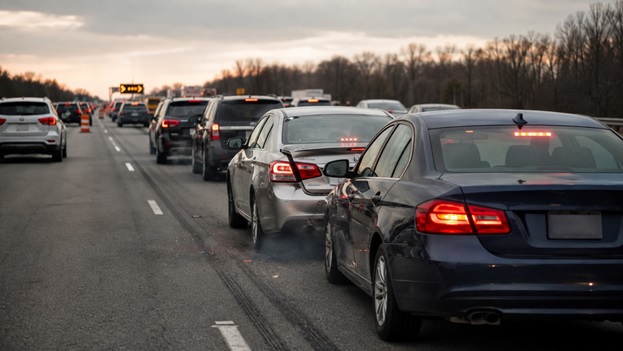
You are traveling with the flow of traffic when suddenly the brake lights ahead of you turn red. Cars begin slowing rapidly, someone slams on their brakes, and within seconds, a routine drive turns into a serious collision.
As a personal injury attorney, I know that rear-end accidents caused by sudden traffic slowdowns can happen incredibly fast. Sudden traffic slowdown accidents are especially common on highways, interstates, bridges, construction zones, and heavily traveled commuter routes, where vehicles may be moving faster before traffic unexpectedly backs up.
After one of these crashes, people often assume the driver who rear-ended another vehicle is automatically responsible. While following distance and driver attention matter, liability isn’t always that simple.
For example, why traffic slowed, how much warning drivers had, and whether everyone involved was driving reasonably for the conditions all factor into the liability analysis.
Why Do Sudden Traffic Slowdown Accidents Happen?
Traffic doesn’t always slow gradually.
A collision farther ahead may force vehicles to stop abruptly. Construction can unexpectedly close a lane. A disabled vehicle may block traffic. Congestion around an interchange can cause vehicles traveling at highway speeds to encounter nearly stopped traffic within a relatively short distance.
Whatever the reason, drivers approaching the slowdown must recognize what is happening and respond quickly.
Common causes of sudden traffic slowdown accidents include:
- Heavy traffic congestion
- Rush-hour traffic
- Construction zones
- Lane closures
- Earlier accidents
- Disabled vehicles
- Sudden braking
- Distracted driving
- Following too closely
- Speeding
- Poor weather
- Reduced visibility
- Highway bottlenecks
- Unsafe lane changes
Sometimes the slowdown itself is unavoidable. The accident that follows may not be.
Rear-End Collisions During Sudden Traffic Slowdowns
One of the most common types of crashes associated with unexpected congestion is a rear-end collision.
A driver sees brake lights too late and crashes into the vehicle ahead. Sometimes that impact pushes the first vehicle into another car, creating a chain reaction collision involving several motorists.
- Common Reasons for Rear-End Accidents
Was the approaching driver paying attention, maintaining a reasonable following distance, and traveling at a safe speed for the conditions? - A driver who is texting, looking at a navigation system, adjusting something inside the vehicle, or simply following too closely may have less time to respond when traffic suddenly stops.
At highway speeds, even a brief delay in recognizing stopped traffic can make a significant difference.
Is the Rear Driver Always Responsible?
It is easy to assume that whoever hits the back of another vehicle must automatically be at fault.
Often, the rear driver’s actions are an important part of determining liability. However, you should not assume that the driver in the rear is always liable for the injuries to the occupants of the vehicle that is struck.
Rear-End Accident Analysis and Considerations
- Did traffic gradually slow, or did vehicles suddenly stop?
- Was the rear driver following too closely?
- Was another vehicle changing lanes immediately before the collision?
- Was one car pushed forward after being struck from behind?
- Were there hazards in the roadway?
Following Too Closely Can Increase Accident Risk
Drivers need enough space between vehicles to recognize a hazard, react, and slow down safely.
When someone follows too closely, that safety margin shrinks and can be particularly dangerous on highways, where traffic may suddenly transition from 60 or 70 miles per hour to a crawl.
The appropriate following distance can depend on numerous factors, including speed, weather, visibility, traffic conditions, and roadway conditions.
When traffic is heavy or unpredictable, leaving additional space can provide valuable reaction time.
If a driver follows another vehicle too closely and cannot stop when traffic slows, that driver’s conduct will become an important factor when determining liability for a rear-end accident.
Distracted Driving and Sudden Traffic Slowdowns
One of the first issues to be considered after an accident involving stopped traffic is whether distraction played a role.
A driver does not have to look away from the road for very long to miss an important change in traffic conditions.
A motorist might be:
- Reading or sending a text
- Looking at a GPS
- Adjusting music
- Reaching for an object
- Eating or drinking
- Talking to passengers
- Looking at an accident on the opposite side of the highway
By the time that driver’s attention returns to the roadway, traffic ahead may already be stopped.
Distracted driving accidents involving sudden traffic slowdowns can be especially serious because the distracted driver may have little or no opportunity to brake before impact.
Speed Matters When Traffic Conditions Change
A posted speed limit represents the maximum legal speed under appropriate conditions. It does not necessarily mean that traveling at that speed is reasonable in every situation.
Heavy congestion, poor weather, limited visibility, construction, and changing traffic patterns may require drivers to slow down.
A driver traveling too fast may be unable to stop safely when approaching an unexpected traffic backup.
Speed can also increase the force of the collision, potentially contributing to more serious injuries.
Construction Zones Can Create Unexpected Traffic Backups
Construction zones are another common location for accidents caused by sudden traffic slowdowns.
Lane closures, merging traffic, construction vehicles, reduced speed limits, and changing roadway patterns can create unexpected backups.
Appropriate warning signs and traffic-control devices can be especially important when motorists approaching at highway speeds need advance notice that traffic is slowing.
When a crash occurs near a construction zone, considerations include whether the slowdown was adequately marked and whether drivers were given reasonable warning of changing traffic conditions.
Depending on the circumstances, liability could potentially involve issues beyond the actions of the individual drivers.
Sudden Slowdowns Can Cause Chain Reaction Collisions
A single rear-end crash can quickly become a multi-vehicle accident.
For example:
The first vehicle stops. The second stops behind it. A third driver fails to stop and crashes into the second vehicle, pushing it forward. Additional vehicles may then become involved.
When this happens, determining fault requires understanding the order of the impacts.
Considerations would include whether each driver stopped successfully before being struck or whether multiple drivers independently failed to stop.
More than one driver’s negligence may potentially contribute to the same chain reaction collision.
Commercial Trucks and Sudden Traffic Slowdowns
Unexpected congestion can be particularly dangerous when commercial trucks are involved.
Large trucks are heavier than passenger vehicles and may require more distance to slow or stop, especially at highway speeds.
Truck drivers need to remain attentive to changing traffic conditions and maintain an appropriate following distance.
If a commercial vehicle crashes into stopped or slowing traffic, an investigation may consider factors such as:
- Vehicle speed
- Following distance
- Driver distraction
- Driver fatigue
- Braking
- Vehicle maintenance
- Hours of service
- Electronic logging information
- Onboard vehicle data
Depending on the circumstances, potential liability could involve the truck driver, trucking company, or another responsible party.
Evidence Matters After a Sudden Traffic Slowdown Accident
After a serious crash, the vehicles themselves tell only part of the story. Useful evidence may include:
- Police accident reports
- Photographs and videos
- Dashcam footage
- Traffic-camera recordings
- Surveillance footage
- Witness statements
- Skid marks
- Vehicle damage
- Electronic vehicle data
- Cell phone records when relevant
- Roadway conditions
- Construction-zone information
- Traffic patterns
In some cases, electronic vehicle information may help establish speed, braking, or other vehicle activity immediately before a collision.
This evidence can become particularly valuable when drivers disagree about whether traffic stopped suddenly or how much time they had to react.
What Should You Do After an Accident in Stopped Traffic?
Your health and safety should come first.
Highway accidents involving stopped traffic can create a secondary collision risk because approaching vehicles may not immediately realize an accident has occurred.
If you have been injured, seek appropriate medical attention.
When it is safe and you are physically able, photographs and videos can help preserve important evidence.
Try to document vehicle positions, damage, skid marks, roadway conditions, signs, construction activity, and the surrounding traffic environment.
Avoid speculation about fault at the scene. In a sudden slowdown accident, you may not have been able to see what happened several vehicles behind or ahead of you. Be sure to call the police and collect eyewitness information as soon as possible.
Can You File a Personal Injury Claim After a Sudden Traffic Slowdown Accident?
If another person’s negligence caused or contributed to your injuries, you may have grounds to pursue a personal injury claim after a traffic slowdown accident, depending on the circumstances and applicable law.
Potential damages may include compensation associated with:
- Medical expenses
- Future medical treatment
- Lost income
- Reduced earning capacity
- Pain and suffering
- Property damage
- Other losses permitted under applicable law
Determining who may be responsible requires examining the circumstances of the individual collision.
In a multi-vehicle accident, more than one potentially responsible party or insurance company may be involved.
Injured in an Accident Caused by a Sudden Traffic Slowdown?
If you or someone you love has been injured in a rear-end, highway, or multi-vehicle accident, speaking with an experienced personal injury attorney can help to ensure that you or your loved one gets the deserved compensation.
Contact a Virginia Beach Personal Injury Lawyer
By working with an accident injury attorney in Virginia Beach, you gain access to skilled legal guidance and strong representation. From handling intricate legal matters and negotiating with insurers to advocating for you in court, our experienced injury attorneys ensure you have the best chance of receiving fair compensation for your injuries.
We understand the nuances of Virginia personal injury law. We provide valuable insight into how to approach your case effectively, whether through negotiation with insurance companies or in court.
By working with an auto accident injury attorney in Virginia Beach, you gain access to skilled legal guidance and strong representation.
From handling intricate legal matters and negotiating with insurers to advocating for you in court, our experienced car accident injury lawyers ensure you have the best chance of receiving fair compensation for your injuries.
We understand the nuances of Virginia personal injury law. We can provide valuable insights into how to approach your case effectively, whether through negotiation with insurance companies or in court.
The injury law attorneys at Preston, Wilson & Crandley, PLC advocate on your behalf, ensuring that you are treated fairly and that your case is presented effectively.
Contact Preston, Wilson & Crandley, PLC at (757) 486-2700.
Follow us on Facebook.