


When someone else’s carelessness in a Virginia automobile accident puts you in the hospital, a question that may hit you is: What is this case actually worth?
The honest answer? There is no number on a chart. No calculator that spits out a figure. Every claim is different, and what you can recover depends on how bad the injuries are, how clear the fault is, and what insurance covers.
Here is what actually shapes the value of a personal injury claim.
Two Kinds of Damages: What You Lost and How You Suffered

When you file a personal injury claim, you are asking the at-fault party to compensate you for your damages — and damages break down into two categories.
Economic Damages — The Bills and the Numbers
These are the losses you can document. Hospital bills, pay stubs, invoices.
Medical expenses usually make up the biggest chunk. That includes everything from the ambulance ride to the ER visit to months of physical therapy afterward. If your injury is permanent, future medical costs count too — surgeries down the road, ongoing care, specialist visits that have not happened yet.
Lost wages are exactly what they sound like — income you missed while you were recovering. But for serious injuries, the bigger number is often lost earning capacity: what you would have earned over your lifetime versus what you will realistically earn now.
Non-Economic Damages — What Cannot Be Itemized
These are harder to put a number on, but they can be the most significant part of a serious claim.
Pain and suffering cover the physical experience of what you have been through — and what you will continue to go through.
Emotional distress addresses the mental toll: anxiety, depression, PTSD, and the inability to sleep soundly since the accident.
Loss of enjoyment of life speaks to what the injury took from you — the hobbies you can no longer do, the activities you used to love, the version of daily life you no longer have access to.
These are not soft numbers. In catastrophic cases, non-economic damages can dwarf the medical bills.
Four Factors That Drive Settlement Value
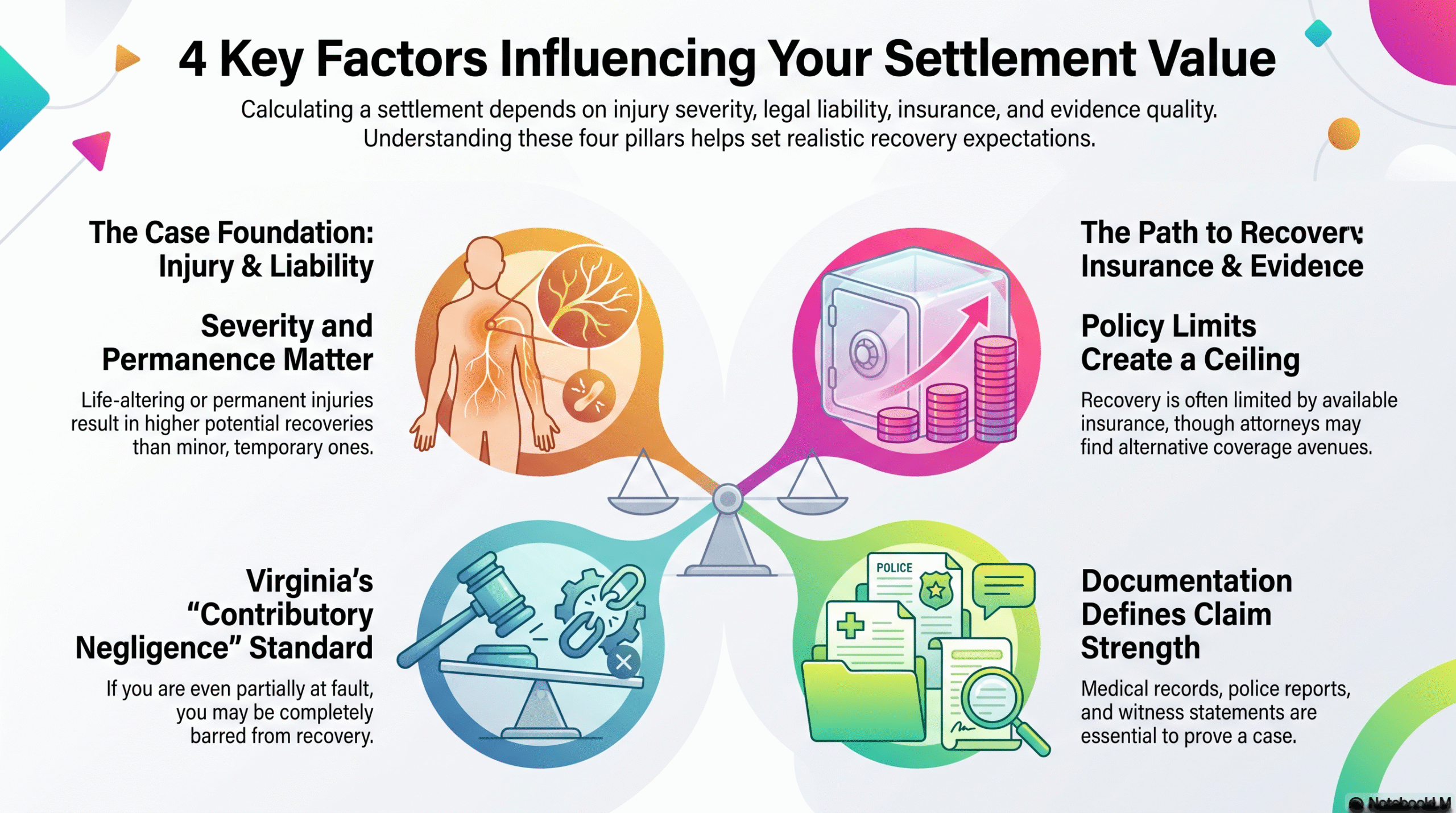
Damages are the foundation, but they are not the whole story.
1. How Serious — and How Permanent — Is the Injury?
A broken wrist that heals in six weeks and a spinal cord injury that changes the rest of your life are not the same conversation. Severity and permanence matter enormously. The more life-altering the injury, the higher the potential recovery.
2. How Clear Is the Fault?
The stronger the case against the other party, the stronger your claim. Virginia, however, uses a tough standard called contributory negligence. Under Virginia law, if you were even partially at fault for the accident, you may be completely barred from recovering anything. That is not a small detail — it is a rule that can end a case before it starts. This is exactly why having an experienced attorney assess your case early on matters.
3. What Are the Insurance Policy Limits?
Here is a hard truth: even if your damages are enormous, your recovery is often limited by what insurance is available. If the at-fault driver only carries a minimum-limit policy, that ceiling can be frustratingly low. An attorney can look for other avenues — the defendant’s personal assets in rare cases, or your own underinsured/uninsured motorist coverage if you have it.
4. How Strong Is Your Documentation?
A claim is only as good as the evidence behind it. Medical records, police reports, witness statements, photos from the scene, and a clear paper trail of lost income — these are what separate a strong case from a weak one.
One thing people do not realize: if you stop treatment early or skip your doctor’s follow-ups, the insurance company will use that against you. Gaps in care can seriously deflate your claim’s value.
What Do Settlements Actually Look Like?
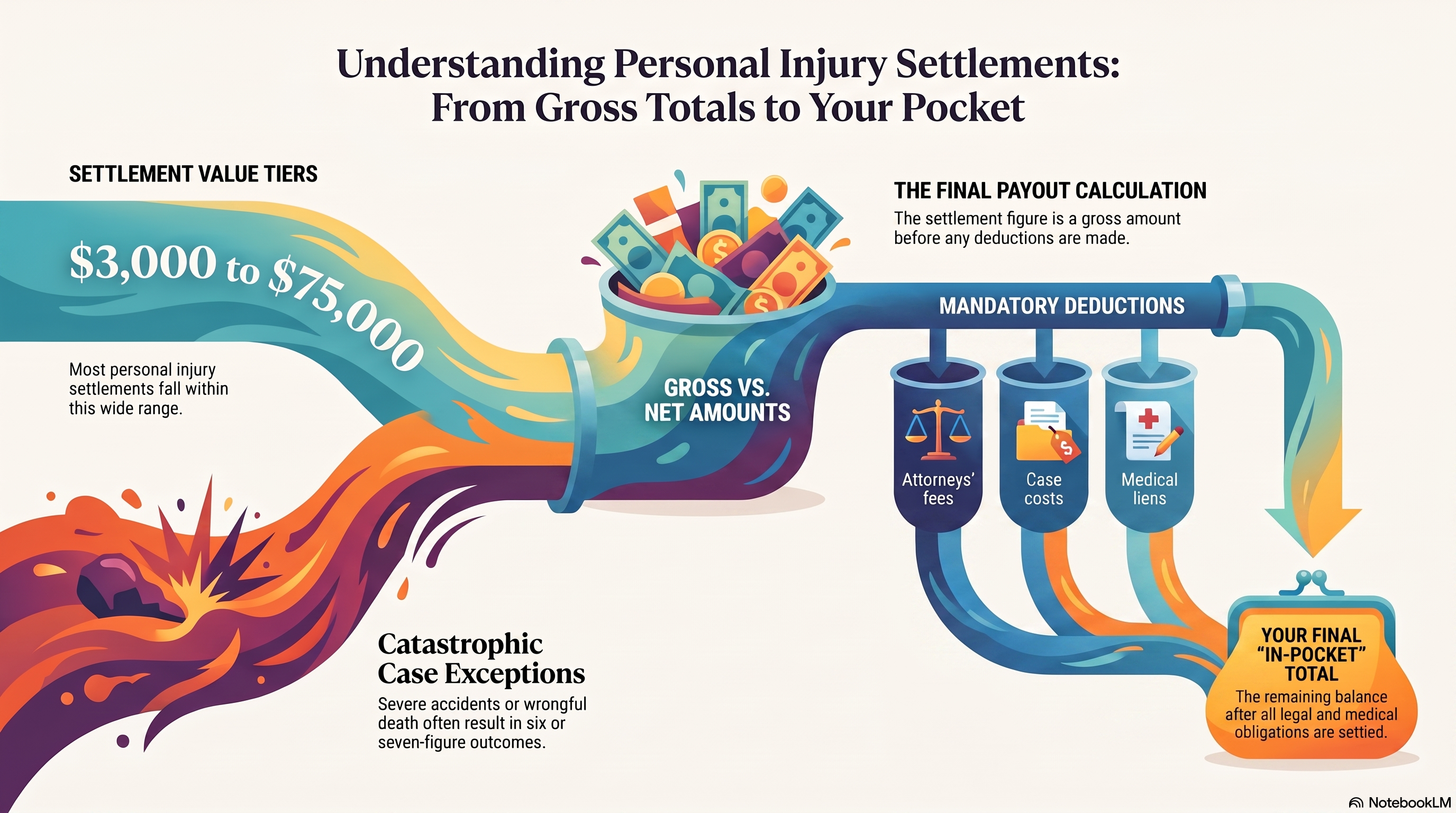
Most personal injury settlements land somewhere between $3,000 and $75,000. That is a wide range, reflecting the diversity of claims.
Catastrophic cases — wrongful death, severe truck accidents, traumatic brain injuries — often produce settlements or verdicts in the hundreds of thousands or well into the millions.
One more thing to keep in mind: those figures are gross amounts. Attorneys’ fees, case costs, and unpaid medical liens come out first. What is left after that is what actually goes into your pocket.
Why Going It Alone Usually Costs You

Insurance adjusters do this every day. Their job is to close claims for as little as possible, and they are good at it. Going up against them without an attorney is fighting with one hand tied behind your back.
A seasoned personal injury attorney does three things that make a real difference:
- Builds a complete picture of your damages — including future losses you might not even know you are entitled to.
- Negotiates hard — knowing the tactics insurers use and how to counter them.
- Takes it to trial if necessary — not every case settles, and having a lawyer ready to litigate changes the dynamic at the negotiating table.
The only way to know what your case is genuinely worth is to sit down with an experienced attorney and go through it.
Which Court Handles Your Virginia Personal Injury Lawsuit?

If your case heads to litigation in Virginia, it gets filed in one of two courts, depending on the amount at stake.
General District Court handles claims up to $50,000. It is faster, less expensive to litigate, and — importantly for smaller claims — allows your medical records to be introduced through an affidavit rather than requiring your doctors to testify in person. That alone can save you significant money. A judge, not a jury, decides the outcome. If either side disagrees with the outcome, they can appeal to Circuit Court, where a jury takes over.
Circuit Court handles more serious cases — any claim above $4,500 qualifies, and for significant injuries, this is typically where you want to be. There is no cap on what you can ask for (though what you receive is determined by the jury, and it cannot exceed what you requested). The tradeoff is cost and time: Circuit Court litigation is more involved and more expensive.
Where to file is not always obvious. The decision depends on the specifics of your case, and getting that call right from the start can matter. Our Virginia Beach personal injury attorneys can walk you through it.
Schedule a Consultation with Preston, Wilson & Crandley, PLC

By working with an accident injury attorney in Virginia Beach, you gain access to skilled legal guidance and strong representation. From handling intricate legal matters and negotiating with insurers to advocating for you in court, our experienced injury attorneys ensure you have the best chance of receiving fair compensation for your injuries.
We understand the nuances of Virginia personal injury law. We provide valuable insight into how to approach your case effectively, whether through negotiation with insurance companies or in court.
By working with an auto accident injury attorney in Virginia Beach, you gain access to skilled legal guidance and strong representation.
From handling intricate legal matters and negotiating with insurers to advocating for you in court, our experienced car accident injury lawyers ensure you have the best chance of receiving fair compensation for your injuries.
We understand the nuances of Virginia personal injury law. We can provide valuable insights into how to approach your case effectively, whether through negotiation with insurance companies or in court.
The injury law attorneys at Preston, Wilson & Crandley, PLC advocate on your behalf, ensuring that you are treated fairly and that your case is presented effectively.
Contact Preston, Wilson & Crandley, PLC at (757) 486-2700.
Follow us on Facebook.